SOL 5: From white to red
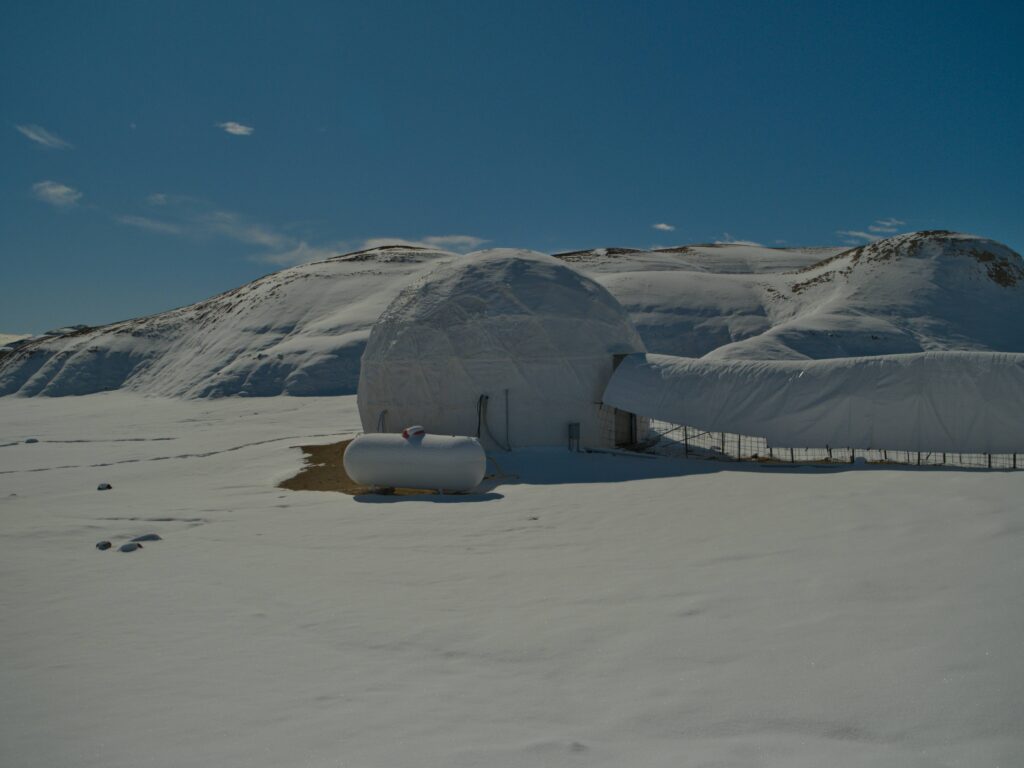
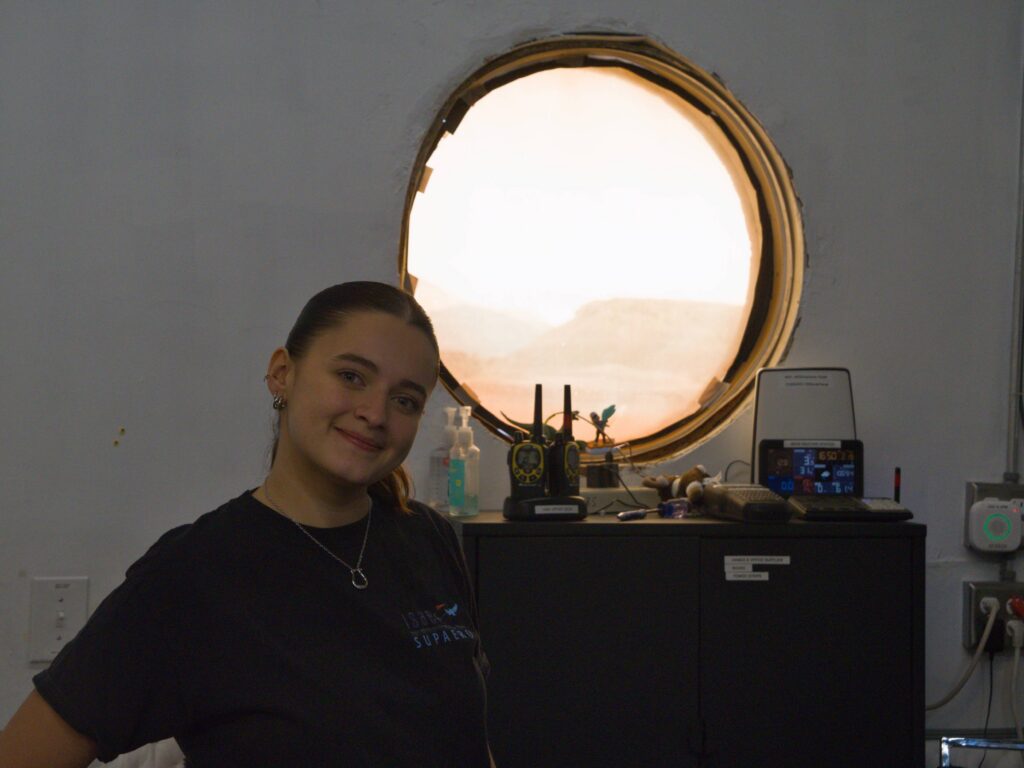
Today, the red planet turned into a white planet. It snowed all night long, and the ground was fully covered. We got to see a new landscape, but we couldn’t go out for an EVA in these conditions. As the day progressed, we watched the snow melt and the redness of Mars reappear in the late afternoon. It was a magnificent spectacle, especially from the Science Dome, which offers the best view of the station.
In the RAM, Célia and Félix finished assembling the Lab’Ex! After five months of hard work to develop this experiment, the whole crew celebrated this accomplishment. Over the radio, we heard this message: “Crew, this is Célia and Félix. We have the pleasure of telling you that the Lab’Ex is completely assembled,” followed by clapping from all the other crew members. The only thing left to do is to test it in the coming days!
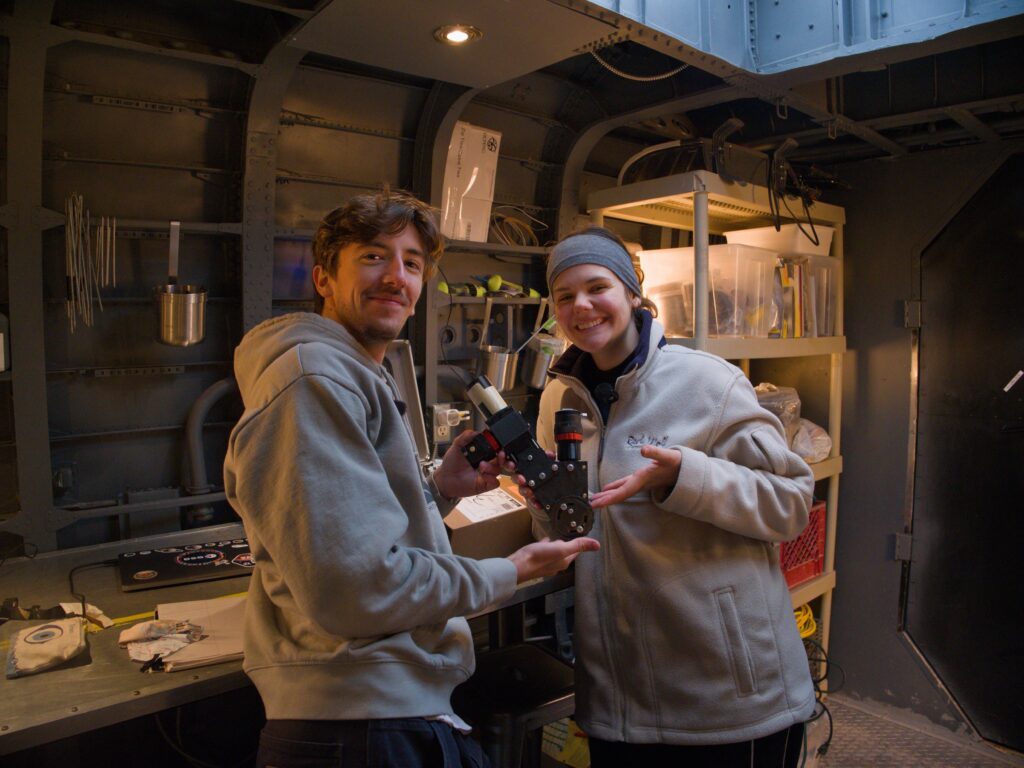
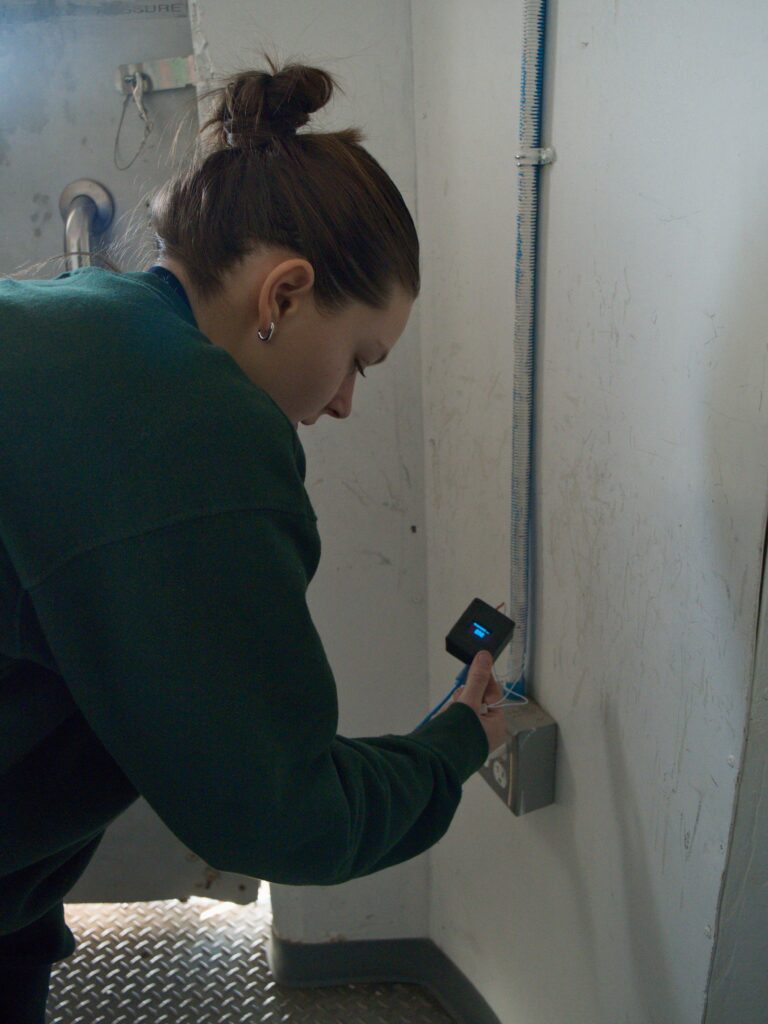
In the meantime, Lou worked on one of her crew engineer projects. When we go outside for an EVA, we must spend five minutes in an airlock to equalize pressure between our station and the Martian environment. For now, we only use a stopwatch, but Lou designed “AirLocks,” which detect when the airlock is closed and start a countdown automatically. She wired them this morning and finalized the code and the assembly this afternoon.
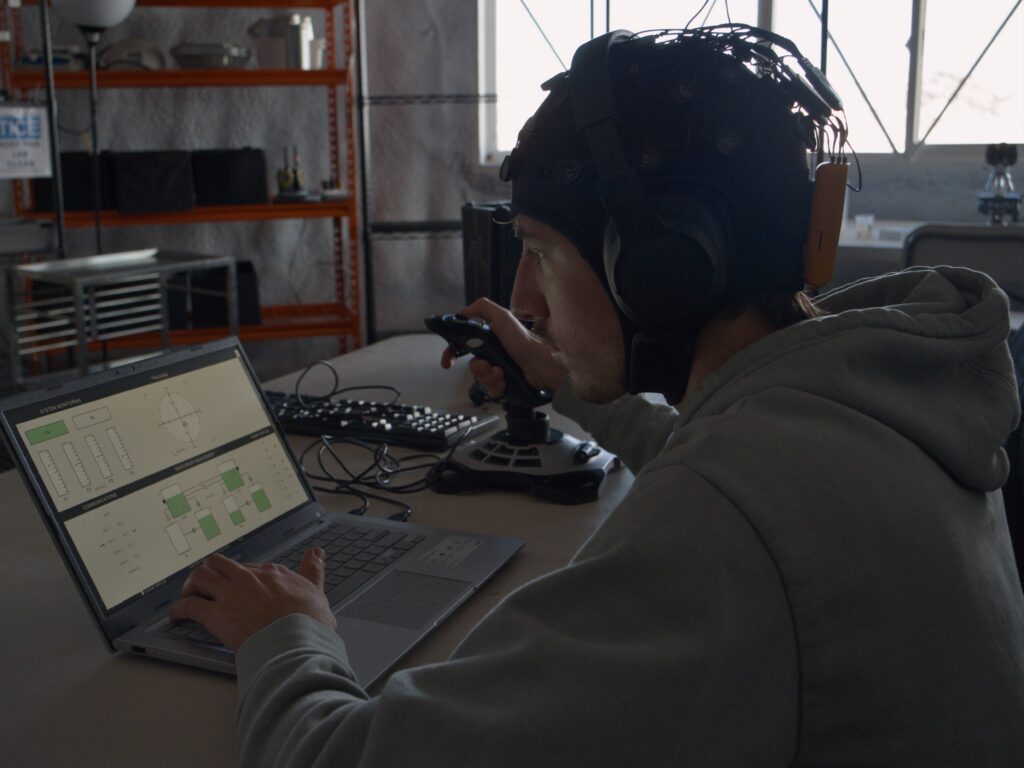
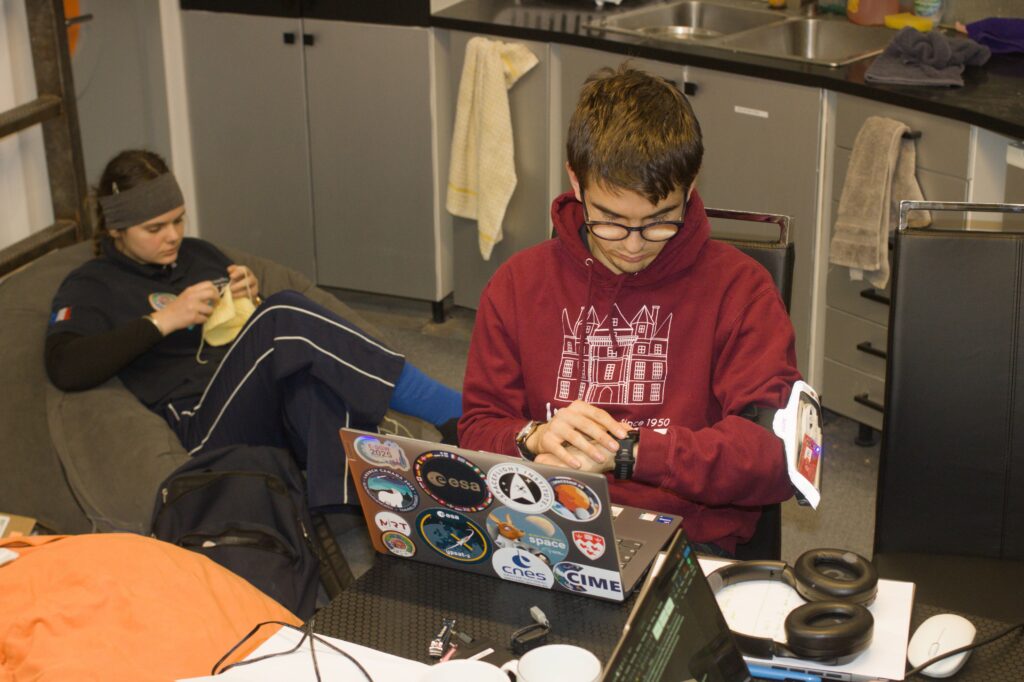
Julien spent the whole day in the Science Dome to coordinate the sessions for the neuroergonomics experiment. Every crew member must perform a cognitive assessment every three days while wearing an electroencephalogram. Researchers from the ISAE-SUPAERO Neuroergonomics Center will then be able to study the impact of confinement on our performance thanks to the measurements of our cerebral activity. Adèle, Félix, Lou, Célia, and I performed one session today. Julien then completed the scientific summary of the week with Gaspard.
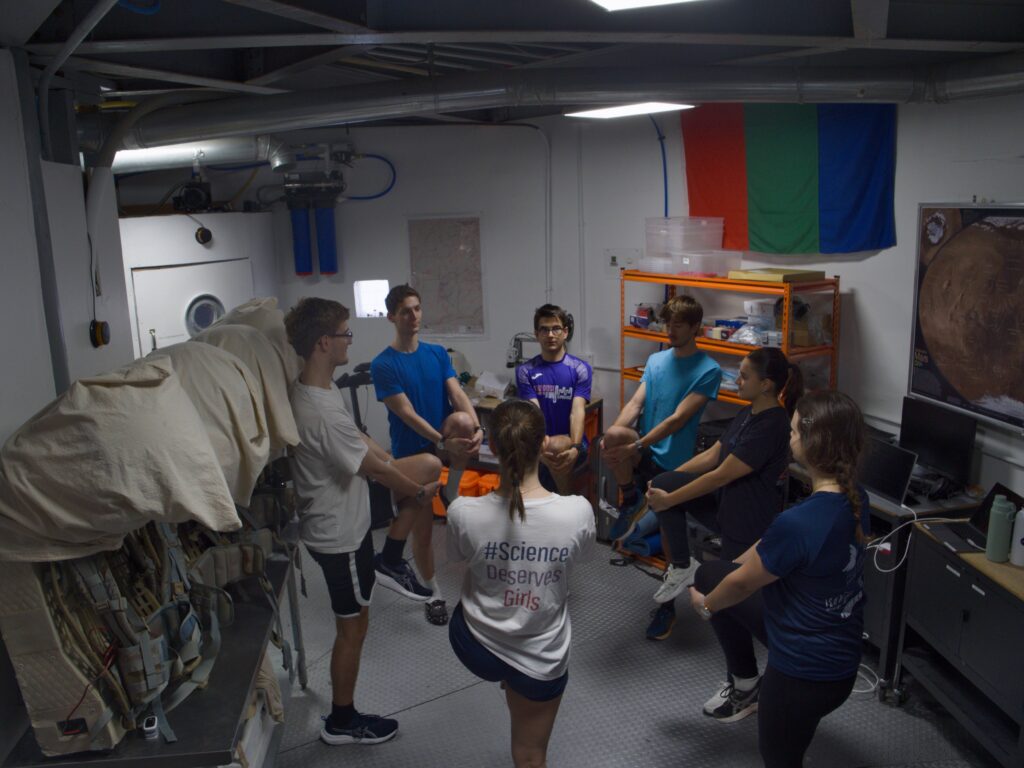
Adèle organized a fun exercise session this morning. The objective was to find papers hidden in the lower deck of the HAB as quickly as possible while the other crewmates were doing an exercise. Early in the afternoon, she headed to the GreenHab with Félix to water the plants.
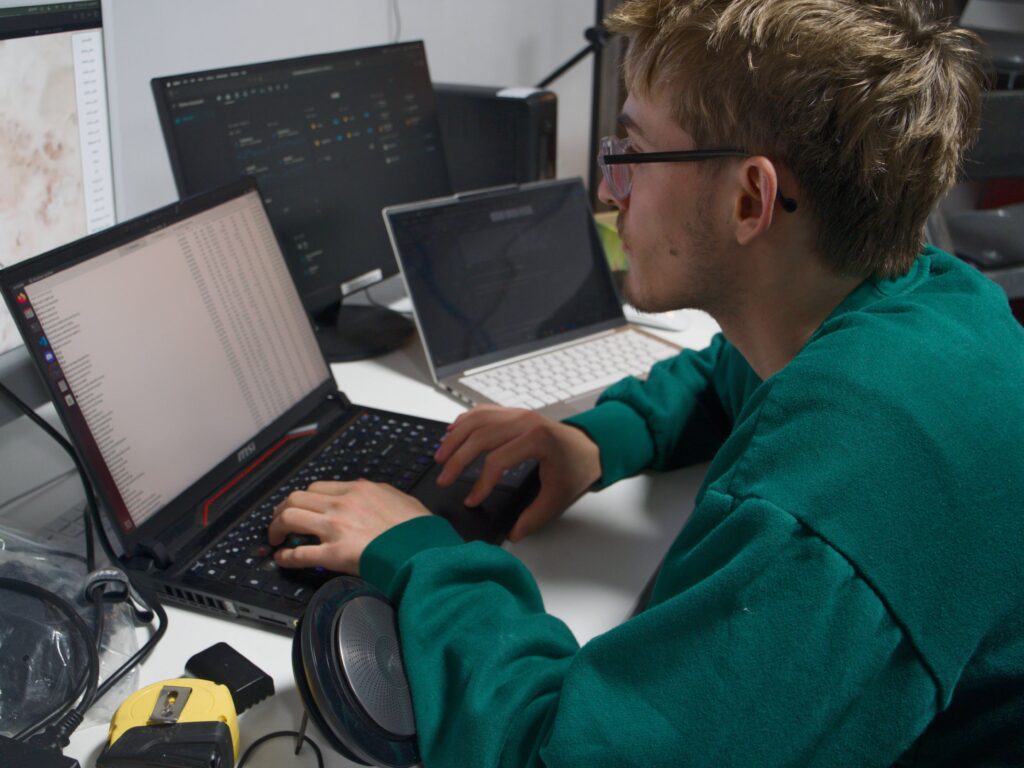
In the afternoon, Gaspard and I worked on AMAIA to continue installing new functionalities. We also solved several issues we encountered during the first days of the mission.
Tomorrow is our rest day. Even on Mars, it is critical to get some free time to relax and recharge our batteries!
SOL 4 : plot twists on Mars
Last night was very eventful. At 9 PM, we received a call from Mission Support, the manager of the base with whom we stay in radio contact in case of anomalies with the operations of the station. Our electricity consumption doubled around 6:30 PM, Gaspard and Lou figured out that the issue came from the water heater. Therefore, we had to go unplug it, but then we ran the risk that the water would freeze overnight, as the temperatures were going to get below freezing.
As on Mars, where the temperatures are very cold, the management of our resources is one of the main stakes in keeping our access to liquid water and the station habitable. In case we didn’t have any water for today, we filled as many containers as we could with water to keep inside the Hab. In the end, this morning, the water tank didn’t freeze, and we still have access to our water.
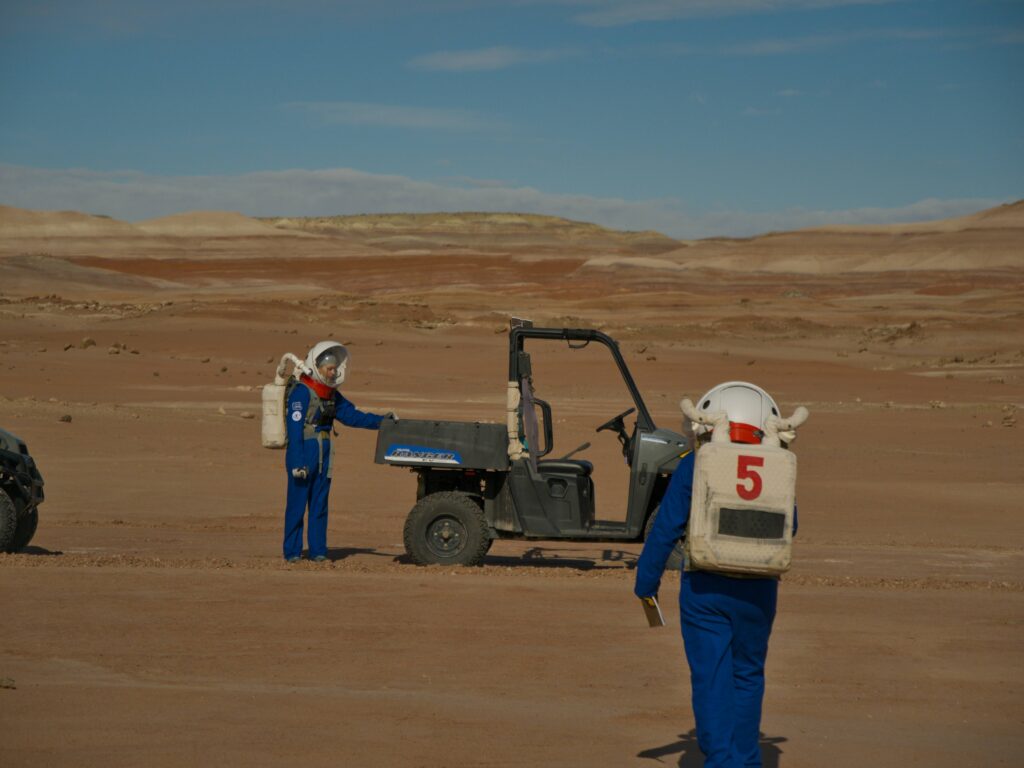
During the first sols, one crewmate who has recently been suffering from asthma-related issues had difficulties during the daily physical activity session, and the safety and health of the whole crew are our absolute priority. As a result, this morning, two crew members had to go with them to get a medical checkup from our orbital station, using our emergency space vehicle. After the medical tests, everyone is, in fact, in great health, and the whole crew was back at the Martian base before noon.
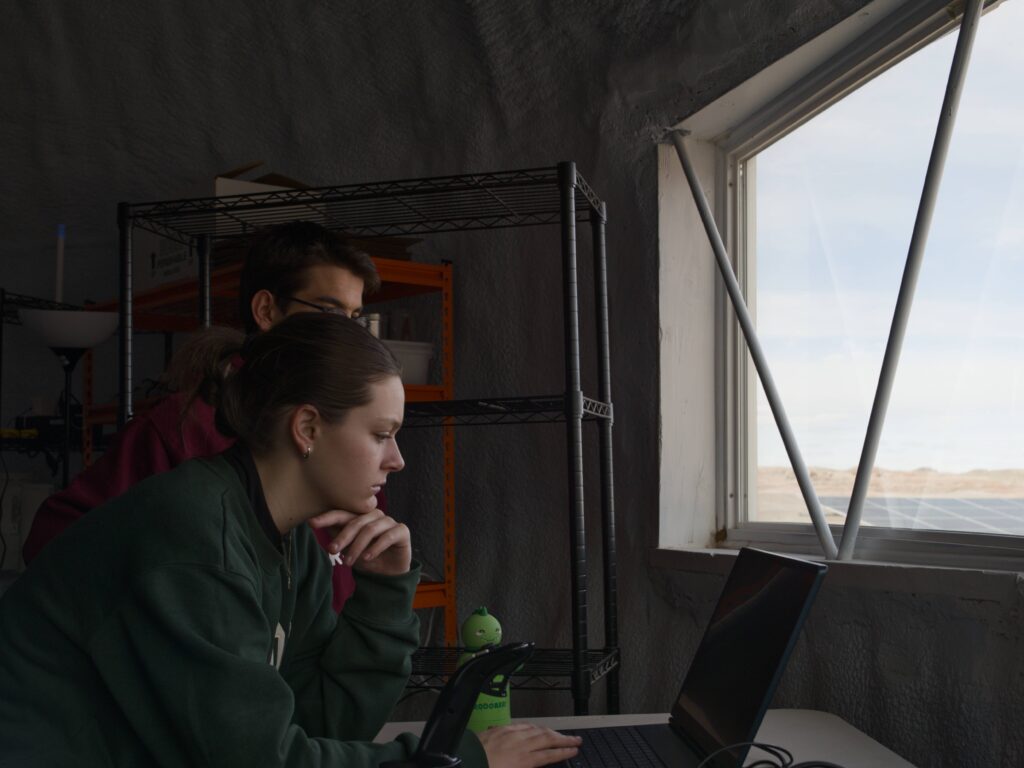
During the day, Célia, Lou and I performed an extravehicular activity to set up LOAC and Field Mill, the atmospheric instruments. Félix acted as CapCom. With the events of the previous day, we could not prepare for the EVA as we should have.
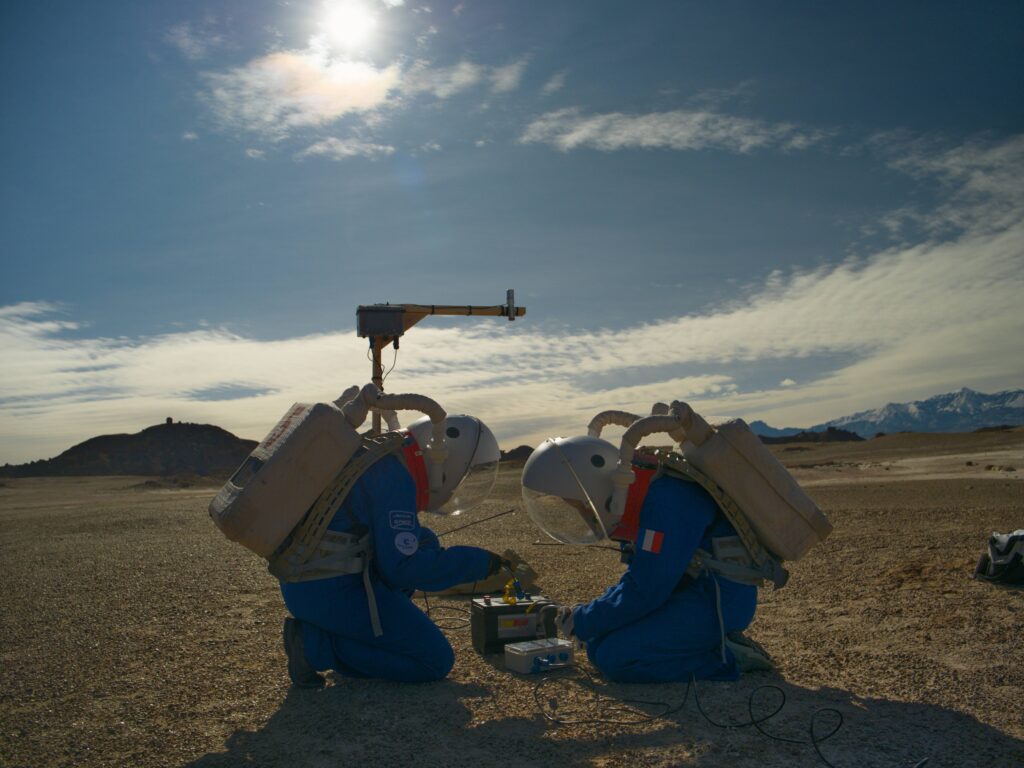
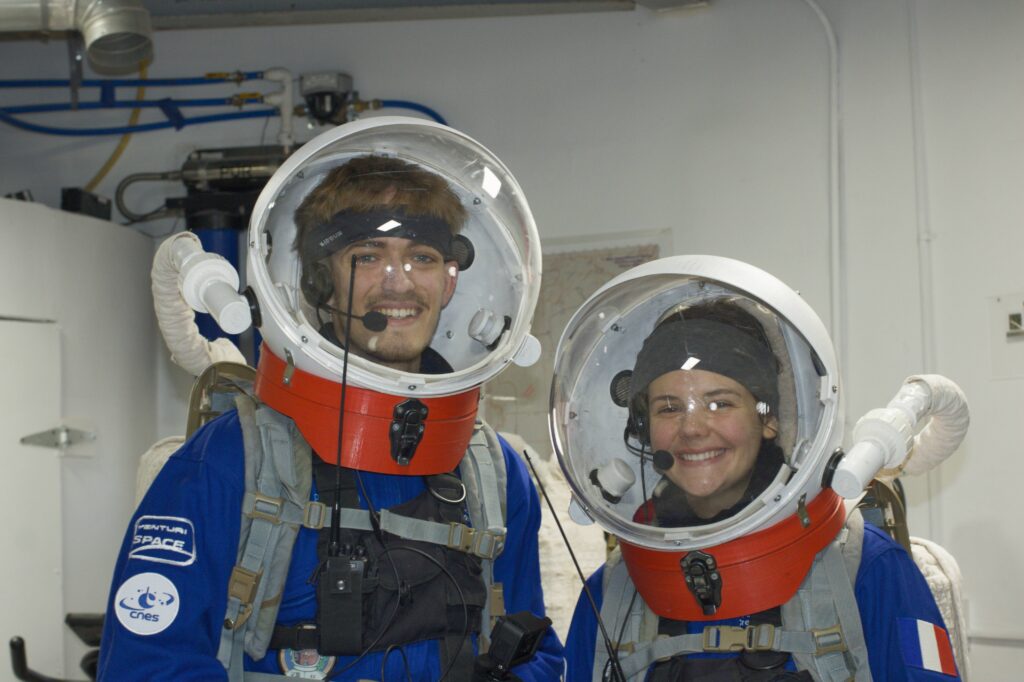
We went to a different location than the one that had been announced to Mission Support and we had to head back to the station. We still had enough time to install the instruments.
Julien and Félix completed their Orbital Architecture assessment in the GreenHab and the Science Dome, respectively. Every session occurs in a different part of the station, so that researchers can study the impact of our environment on our cognitive abilities.
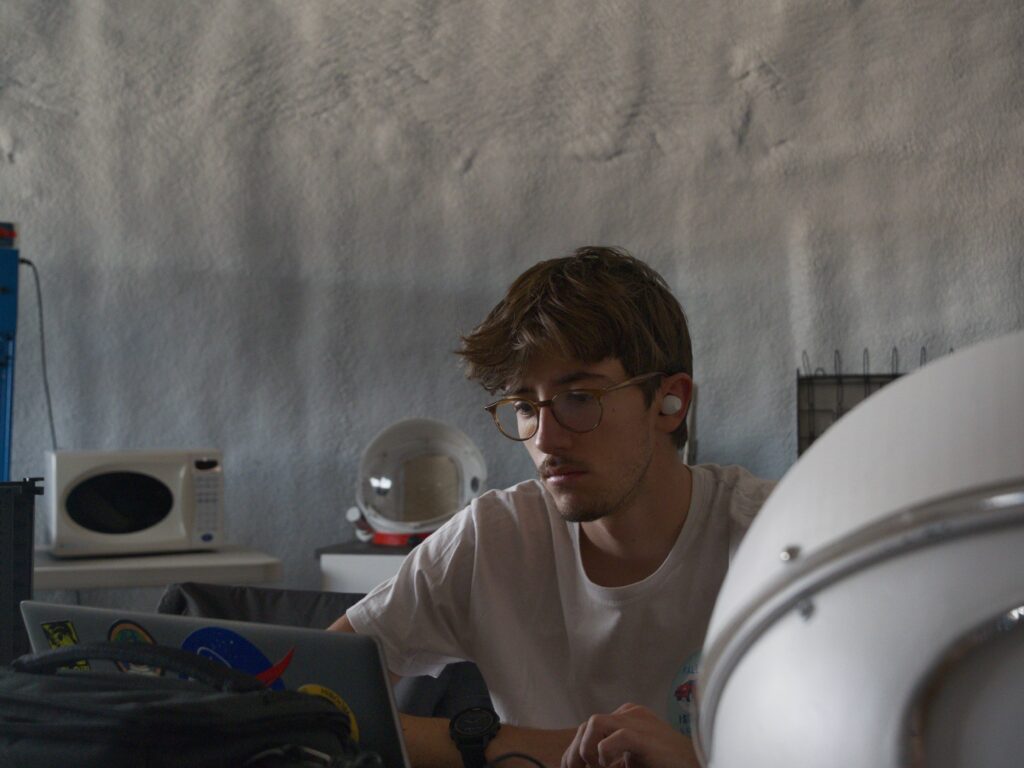
Adèle organized a 45-minute Pilates session, during which we focused on the lower body and core. The goal was to do targeted muscular strengthening with slow movements, focusing on our breathing. Between exercises, we stretched to relax our muscles.
Félix began to plant cucumber and broccoli microgreen seeds in the GreenHab. They will sprout within one or two weeks, which will allow us to eat fresh produce.
Tomorrow, the weather predicts snow, making any EVA impossible.
SOL 3 : Snowflakes on Mars
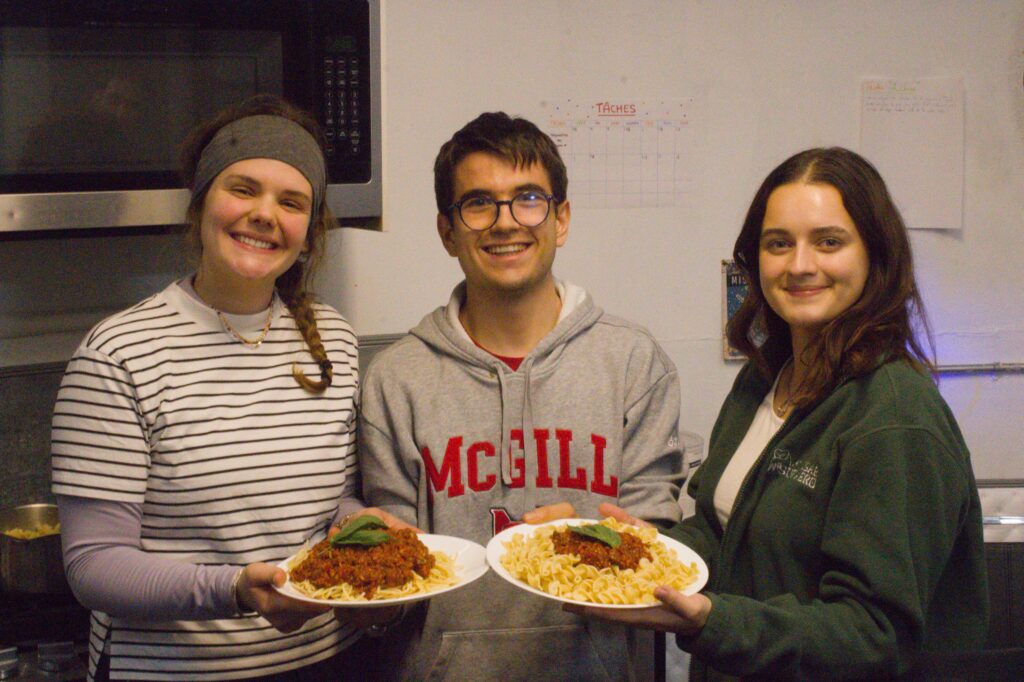
Yesterday, after the communication window, we prepared dinner. For long-duration missions such as those to Mars, food must remain stable for a long time. This is why we eat freeze-dried food, meaning it has been dehydrated to prevent oxidation, which slows down its degradation. We thought that it would not be tasty at all, but with excellent chefs and fresh herbs from the GreenHab, we enjoyed a feast! On the menu were Marinara pasta cooked by Julien and Célia with fresh basil, followed by chocolate chip cookies prepared by Lou and Félix for dessert.
This morning, we collected our physiological data again, then Adèle organized a sports session with cardio, exercises for the entire body and others focusing on the upper body. During a trip to Mars, minimizing the weight onboard the rocket will be critical, and using resistance bands is an amazing solution! For the second day in a row, the weather does not allow us to perform an EVA. Around 11 am, it was even snowing lightly on Mars. The view from the HAB window was particularly beautiful!
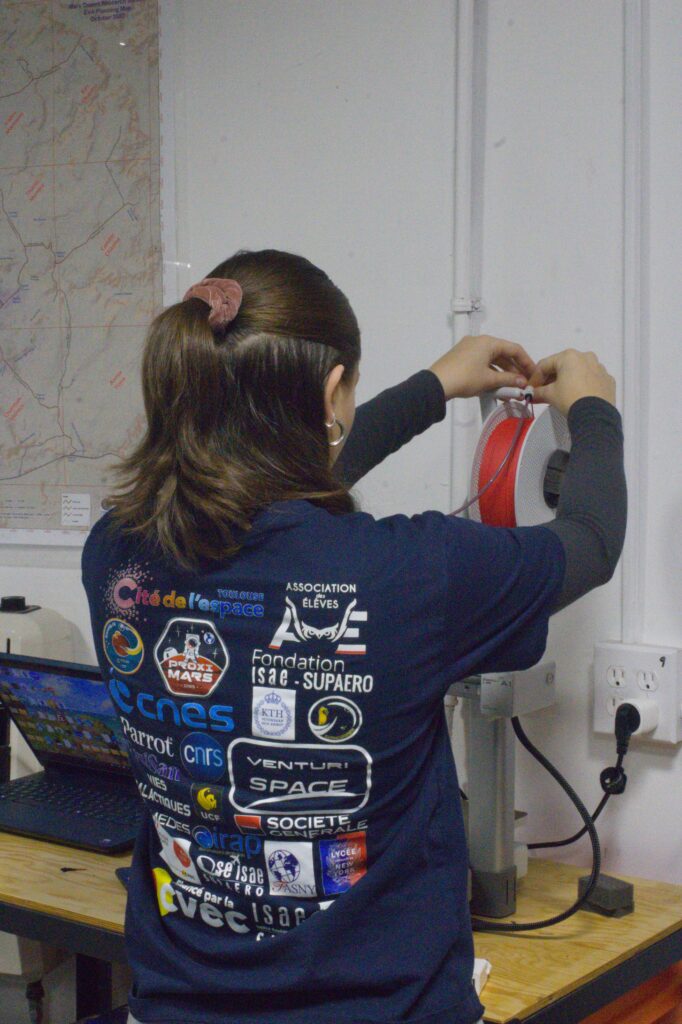
Instead, Julien and Gaspard went over the tasks completed yesterday, while Lou started to 3D print items needed for an exploration EVA where two teams will go out after undergoing different training. Next week, one team will head to a location with a 3D map, while the other will only have a 2D map at its disposal. It would be beneficial for a Martian crew to have the most detailed description of their environment possible to identify sites which are both interesting from a scientific point of view and safely accessible. One solution is to use a drone for photogrammetry, which is a way to build 3D mapping by acquiring overlapping images. We thank Parrot for lending us an Anafi AI drone so that we can complete this experiment.
One of our mission’s goals is to conduct public outreach among young students and to tell them about space and science in general. With this in mind, Adèle and I responded to questions sent before the mission by middle school students.
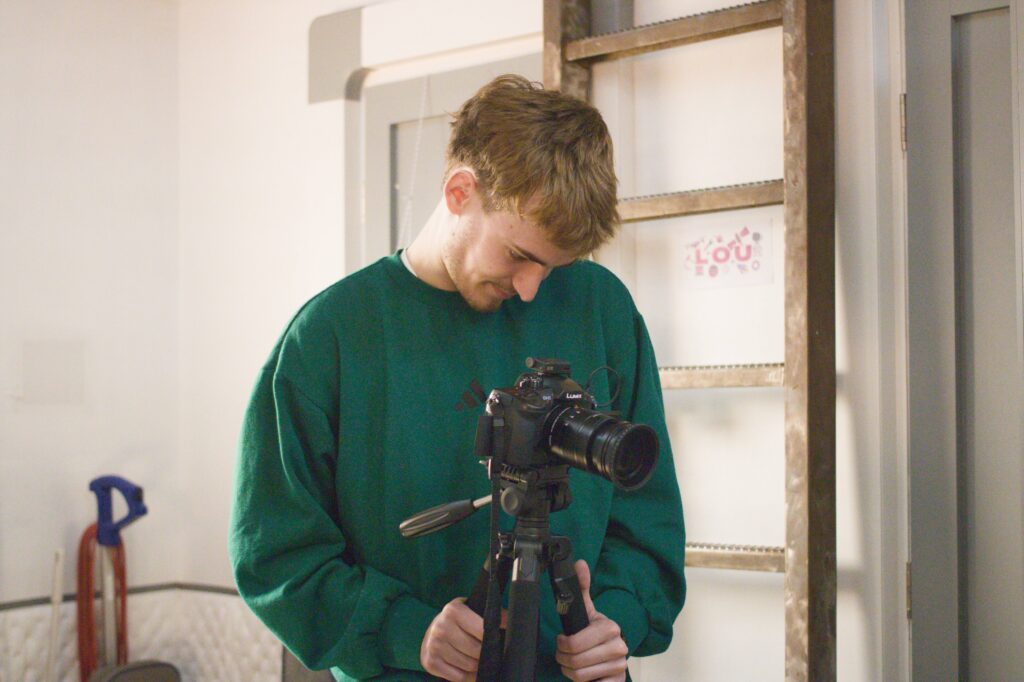
I then went to see Félix and Célia, who were building the Lab’Ex in the RAM, and we were able to shoot some videos for the documentary we are preparing.
In the afternoon, Gaspard helped Lou, Julien and Adèle to fix the neuroergonomics experiment that had not worked during the first few sols. It should work tomorrow.
After a meeting to talk about our technical problems, Gaspard explained the basics of weather forecasting to understand the onset of storms. Observing and preparing are mandatory steps on Mars, as our water supply is precious and sensitive to atmospheric conditions. Tonight’s cold could freeze the water tank, so Gaspard and Lou retrieved some water so that we are sure to have some to drink tomorrow.
In the late afternoon, Félix went to the GreenHab to take care of the radishes he had planted in the morning. We are all starting to feel tired, and some free time slots allow us to engage in more relaxing activities. Some are starting to learn crochet while others are writing about their day.
If all goes well, we should be able to go out tomorrow in order to install the atmospheric instruments.
SOL 2 : A Storm in Mars
The Crew woke up this morning well-rested. Yesterday was quite an intensive day, with a lot of new discoveries and the first obstacles. After the communication
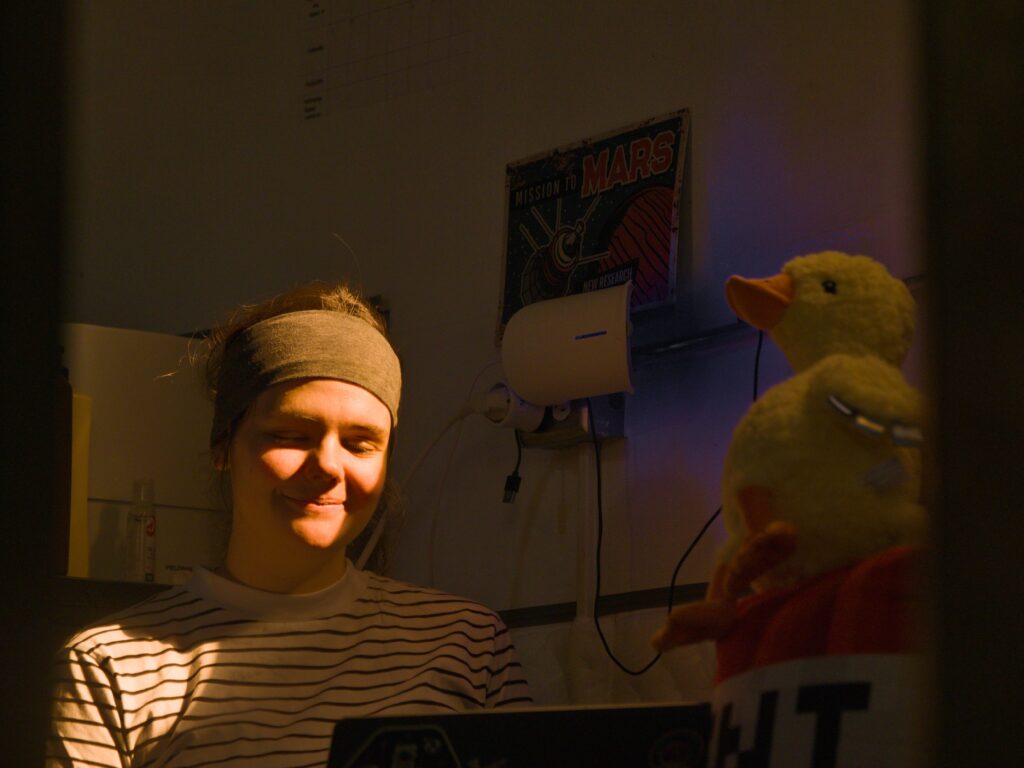
window, we were all exhausted, so Adèle prepared a meditation session for us. We felt completely relaxed. This session was a psychophysical training aiming to calm our spirits and train our attention by concentrating on our breathing and the present moment. It reduced our stress and anxiety, while improving our emotional and physical well-being. We went to bed feeling truly relieved.
When we woke up at 7.15, we did our daily sport session organized and led by Adèle, our Health and Safety Officer. It is crucial to maintain physical activity on Mars, as the transit occurs in microgravity makes the muscles suffer from atrophy.
Sport is therefore the only way to counter this phenomenon.
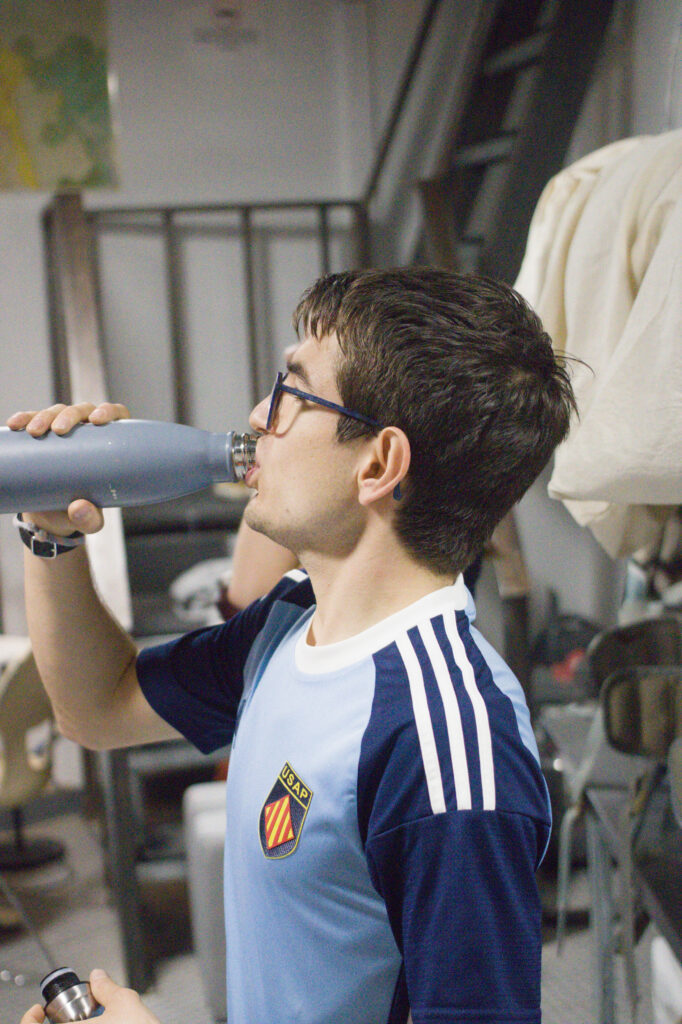
The wind was too strong to go out this morning, and it’s not getting any better as the predictions for the next few days are poor. The EVA planned for Célia, Lou, and me to install the LOAC and the Field Mill experiments had to be canceled due to the weather. Those are two atmospheric experiments. The LOAC experiment
measures the density of particles in the air depending on the speed of the wind, with many uses in the study of particles and their dispersion. The Field Mill aims to study the electrical field in the air. The storm is getting stronger by the day, therefore, we might have to wait until the day after tomorrow to install it. During this newly available time, Célia and Lou installed the Field Mill on its support in the RAM, and I continued installing AMAIA in the HAB.
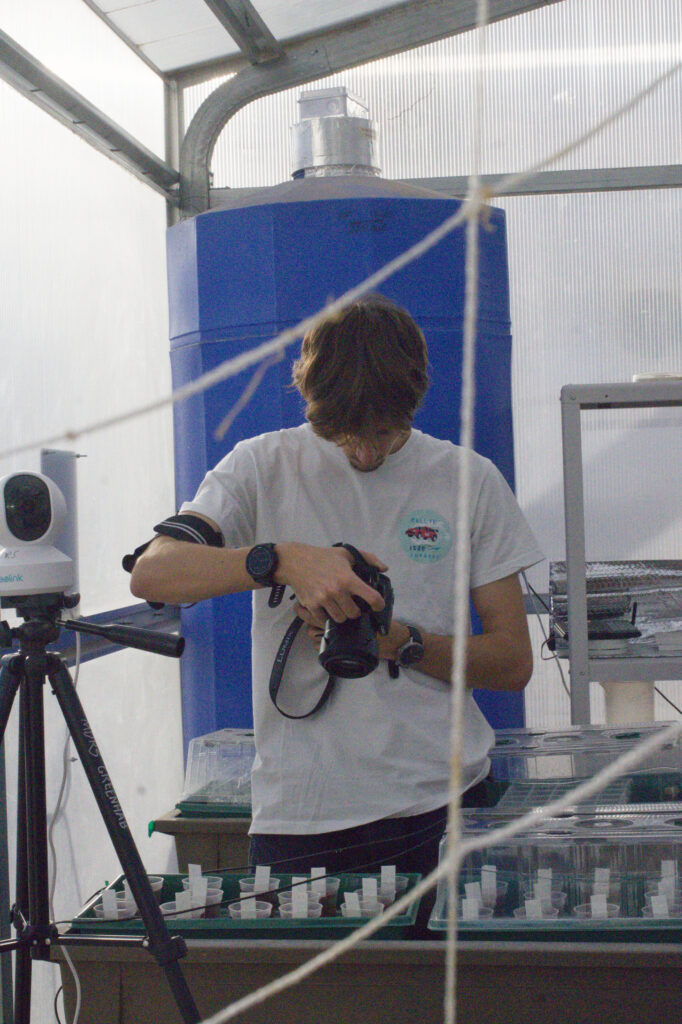
In the meantime, Félix went through the GreenHab inventory and checked the status of the plants which were already growing when we arrived at the station. He started to prepare some radish seeds so that he can plant them tomorrow.
Adèle made the food inventory so that we know what we have at our disposal, before getting the Orbital Architecture experiment ready with Félix. They set up all the phones by connecting them to the GPS and physiological sensors configured yesterday. She also wrote positive thoughts for each one of us. Julien and Gaspard went through the planning and adapted it based on what everyone has been able to complete so far. After lunch, we gathered in the upper deck of the HAB for a brainstorming session aiming to discuss the main technical difficulties we have been facing so far.
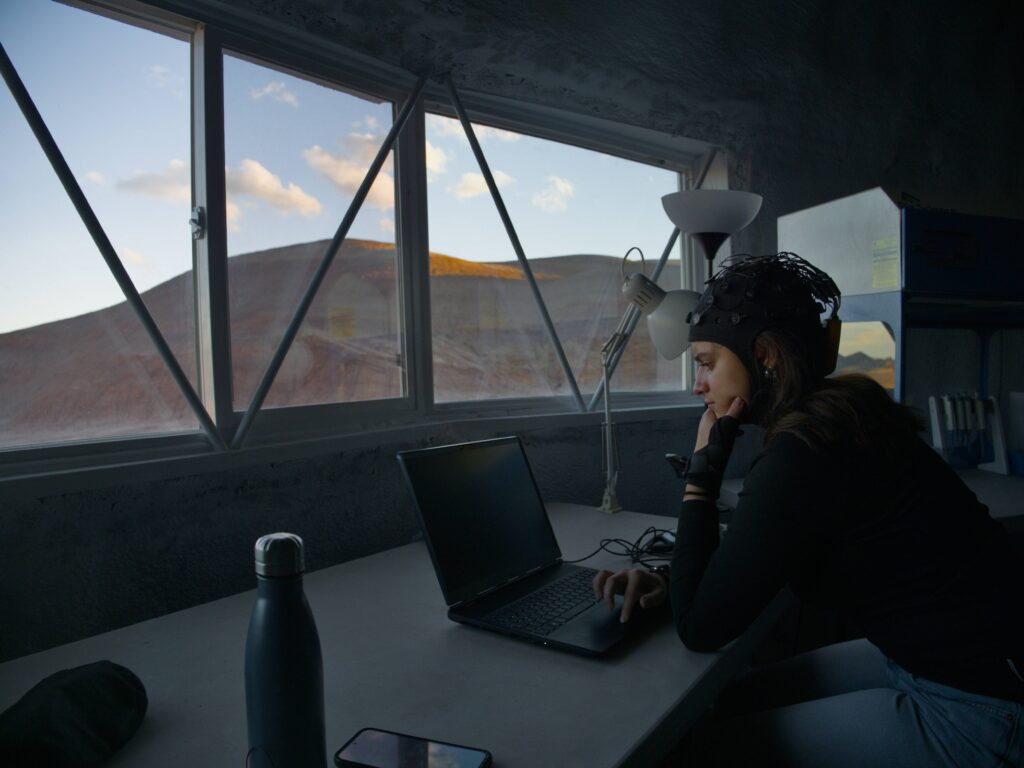
This allowed us to identify potential solutions to implement. Afterwards, everyone spread across the station to continue their tasks. Gaspard, Julien, Adèle, and I went to the Science Dome where several sessions of the neuroergonomics experiment were scheduled.
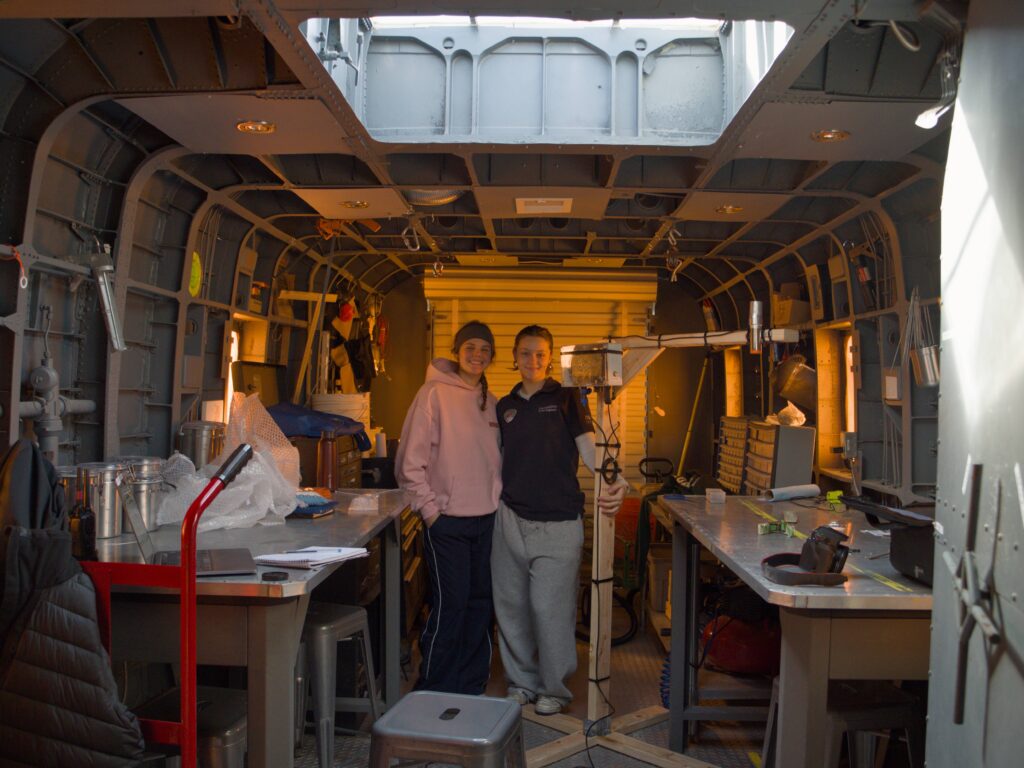
Félix, Célia, and Lou headed to the RAM to start installing the Lab’Ex experiment, the pieces of which have been previously 3D printed. We are now completing our daily asks while waiting for the communication window to Open. We are listening to the wind blowing against the walls of the HAB, the sign of an incoming storm.
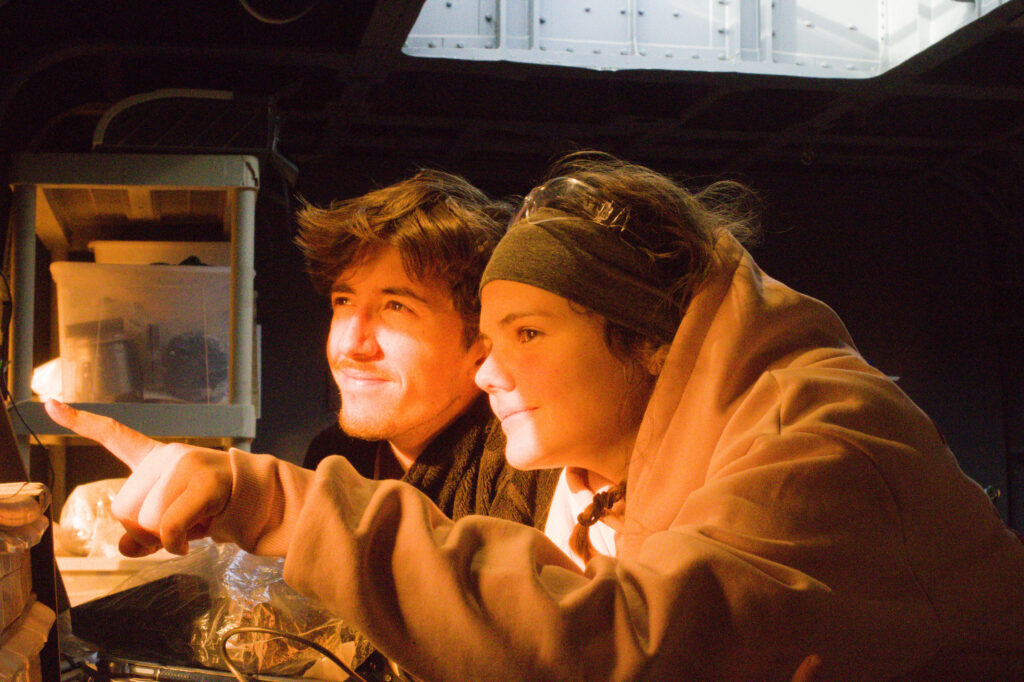
SOL 1 : First steps on Mars
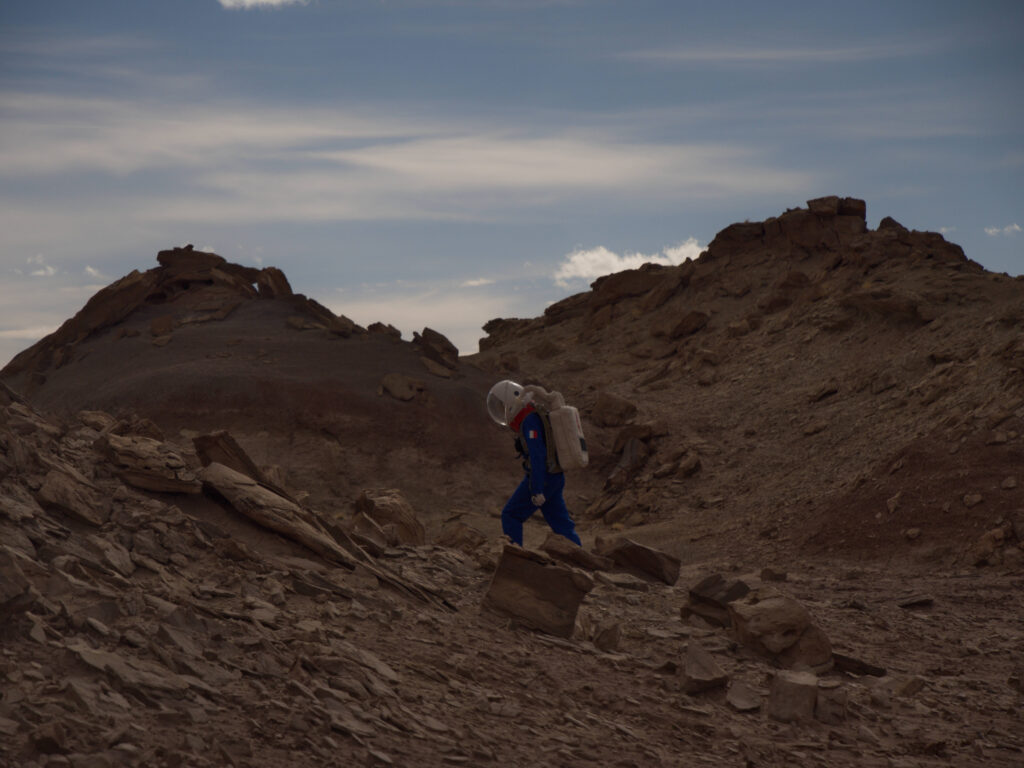
This morning was our very first one on Mars. After a brief night, we experienced the feeling of waking up on a different planet for the very first time. The main goal of the day: taking our first steps on Mars.
First, Julien and Lou set up the Core Data collection upon waking at 7:30 am. We collect physiological data every morning to analyze potential changes throughout the simulation. After having breakfast, we met on the lower deck of the HAB, where Gaspard explained the planning for our very first sol and briefed us on our initiation extravehicular activity (EVA).
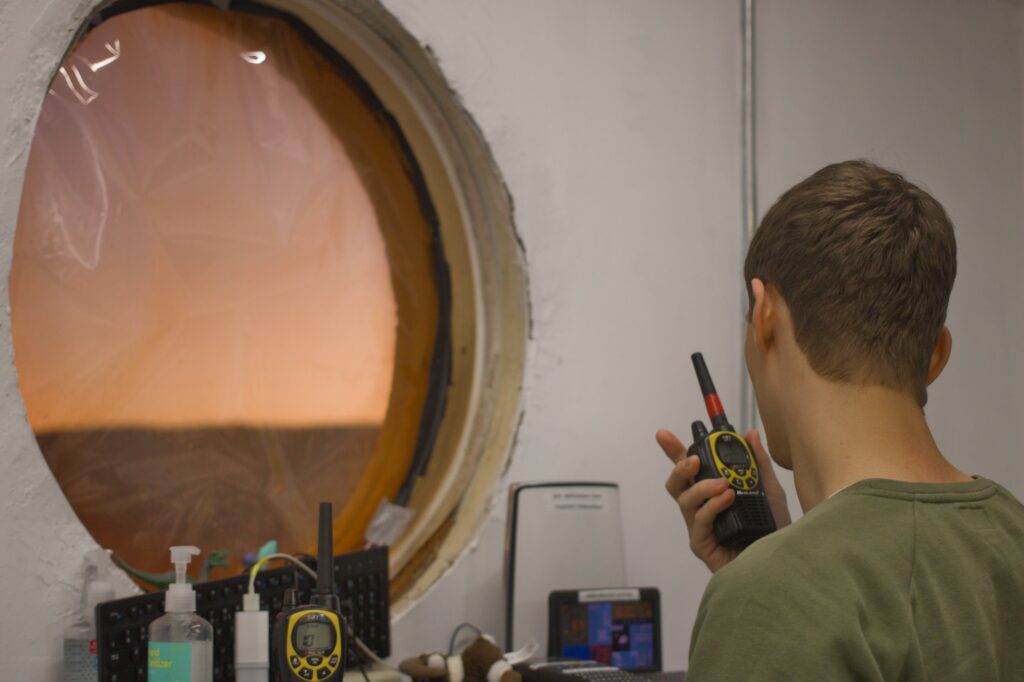
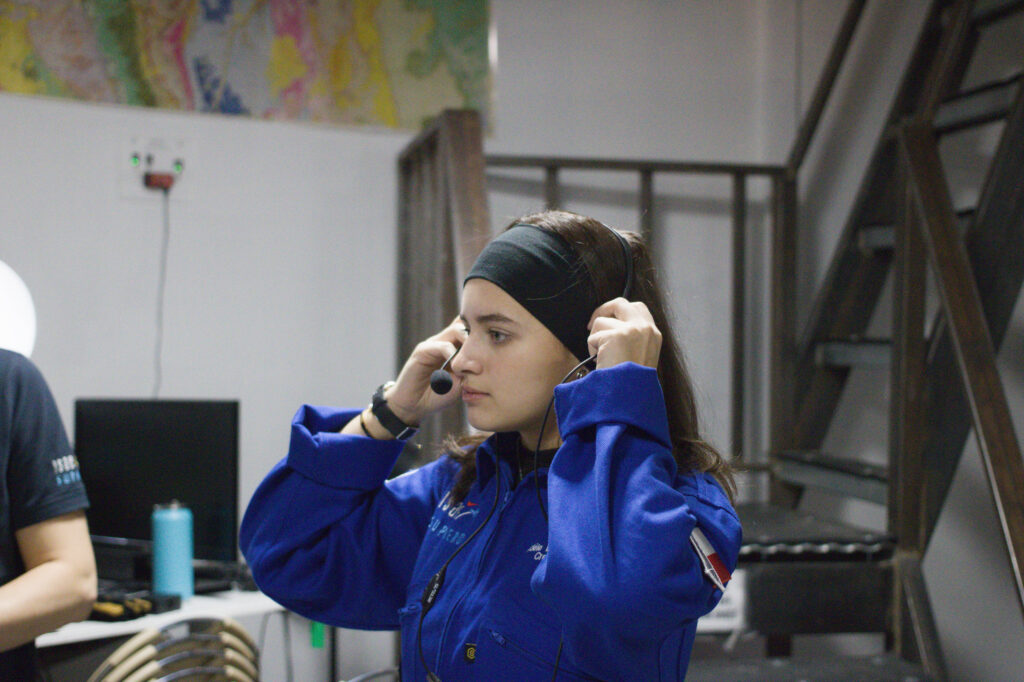
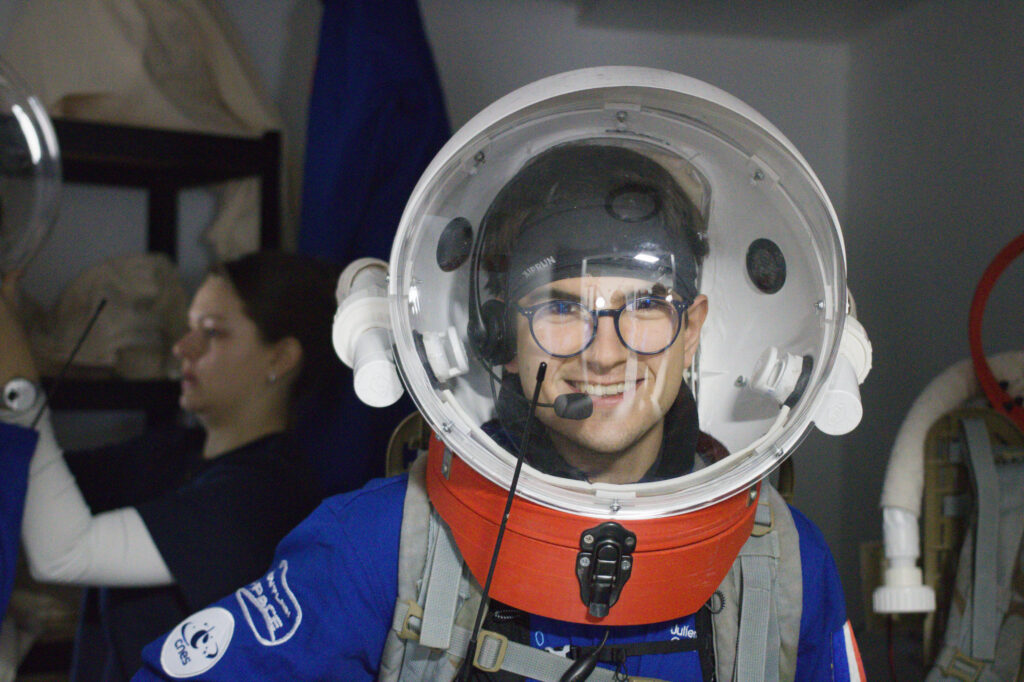
This morning, Adèle, Julien, and Félix went out. Before being able to exit the station, they set up radios so that they could communicate while being outside in their spacesuits. This is also how they stay in touch with the HabCom, who stays within the station and supports the team during their EVA. Gaspard took on this position this morning. Once they were equipped with their spacesuits, they entered the airlock and remained inside for five minutes. This is a mandatory step to go out safely on Mars, where pressure is much lower than inside the station, without danger.
While they were outside, Lou set up the 3D printer while Célia was preparing the Lab’Ex printing, one of our new experiments this year. It consists of analyzing rock composition through spectroscopy measurements and is derived from Star’Ex, which analyzes star composition in a similar way.
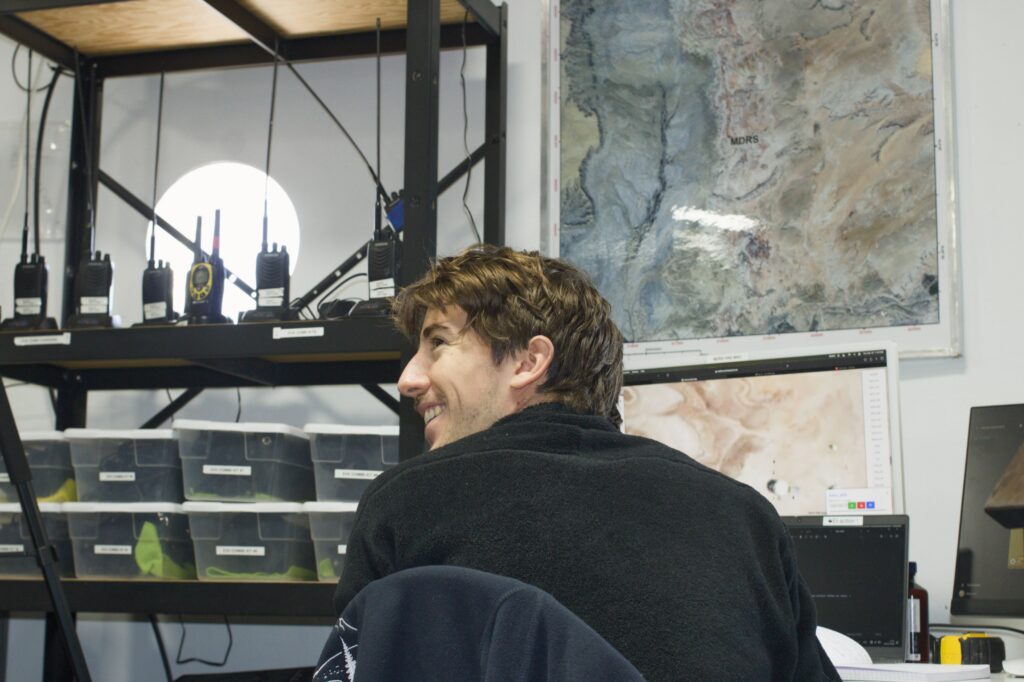
With support from Gaspard, I began to install AMAIA, the astronaut life support artificial intelligence developed by Spaceship FR. We don’t have access to an internet connection except during communication windows, where we can consult our emails to contact our support crew. During the day, we therefore use AMAIA, which works as a standalone application. It allows us to ask questions to a chatbot, upload documents to a local drive, and manage station sensors and our planning. We all have a personal AMAIA tailored to our personal needs and requests.
After spending one hour outside, Adèle, Julien, and Félix came back with large smiles on their faces, demonstrating the magnificent moment they had just experienced. Without revealing the details of their first EVA, they made us understand that they really felt like they were on Mars and that they were left speechless.
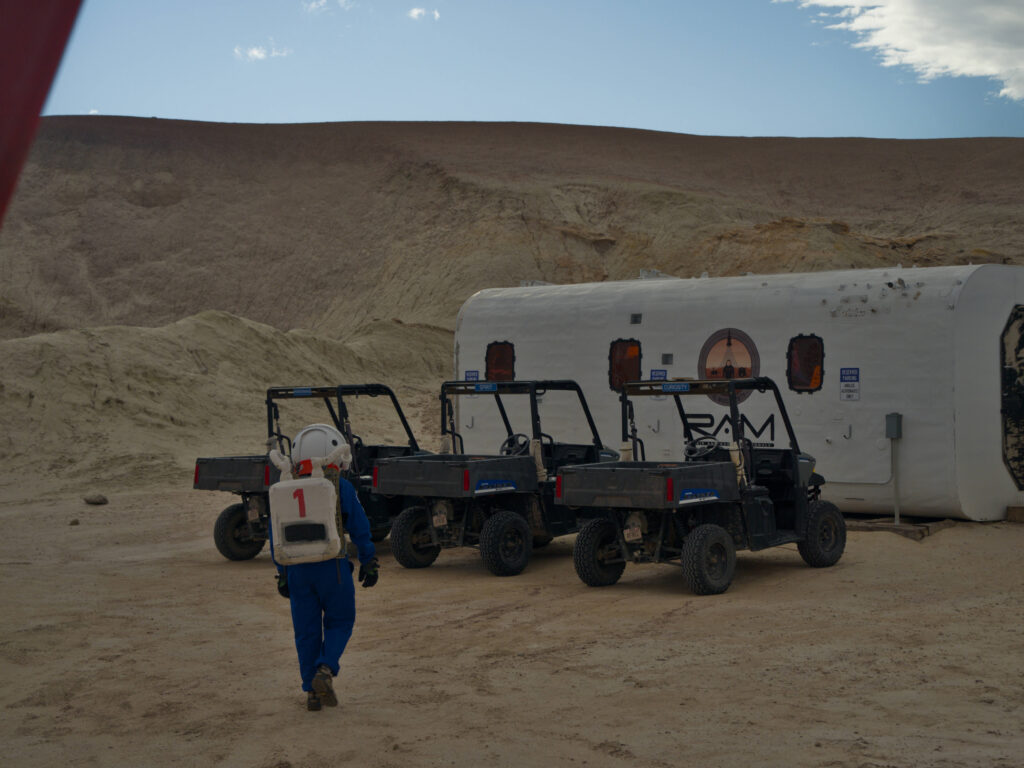
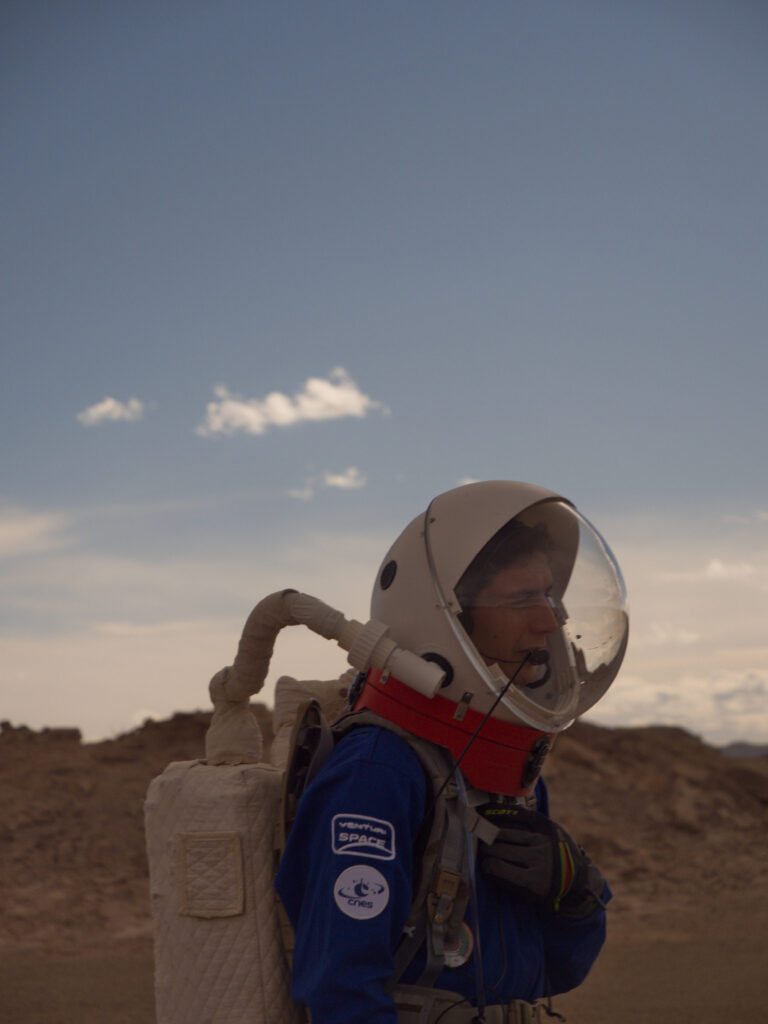
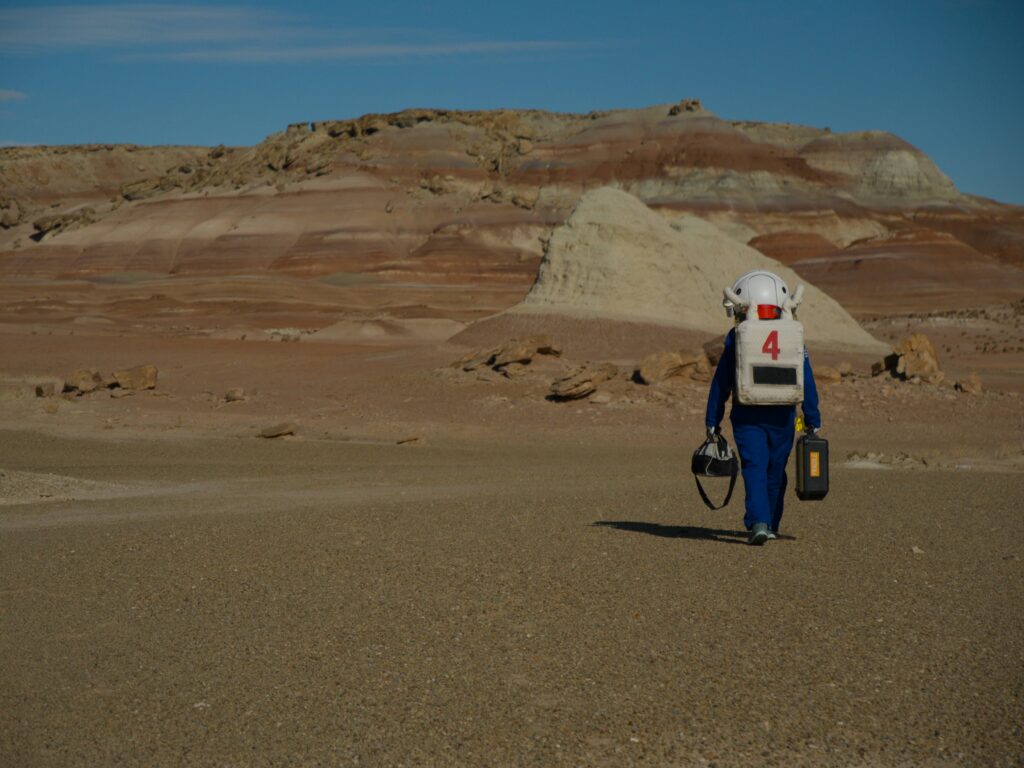
After lunch, it was our turn to undergo the initiation EVA, with Gaspard, Célia, and Lou. We followed the same protocol to be ready to leave the station. Then Julien, our HabCom, let us know that we could go outside. The door opened, revealing a totally different world. This moment was both breathtaking and immersive. We felt a mix of emotions that are tough to describe in words.We went to a place called Marble Ritual with the rovers. We individually chose a rock and put it in a basket in a symbolic manner. Then, we went back to the station on Julien’s command, who told us that the wind was too violent to continue the EVA. A storm is expected tomorrow, and we don’t know if we are going to be able to go out yet. Like the morning group, we went back to the station with huge smiles, eyes full of memories, and a sense of amazement at having experienced this.
During the EVA, Adèle and Félix started to install all the GPS sensors for the Orbital Architecture experiment. This experiment, in cooperation with KTH, aims to evaluate the influence of the environment on cognitive performance. We will have some tasks to conduct in different places of the station while physiological sensors and GPS provide information to researchers about our stress and our environment. They were able to set up the entire station despite a sensor that stopped working and some cable optimization issues.
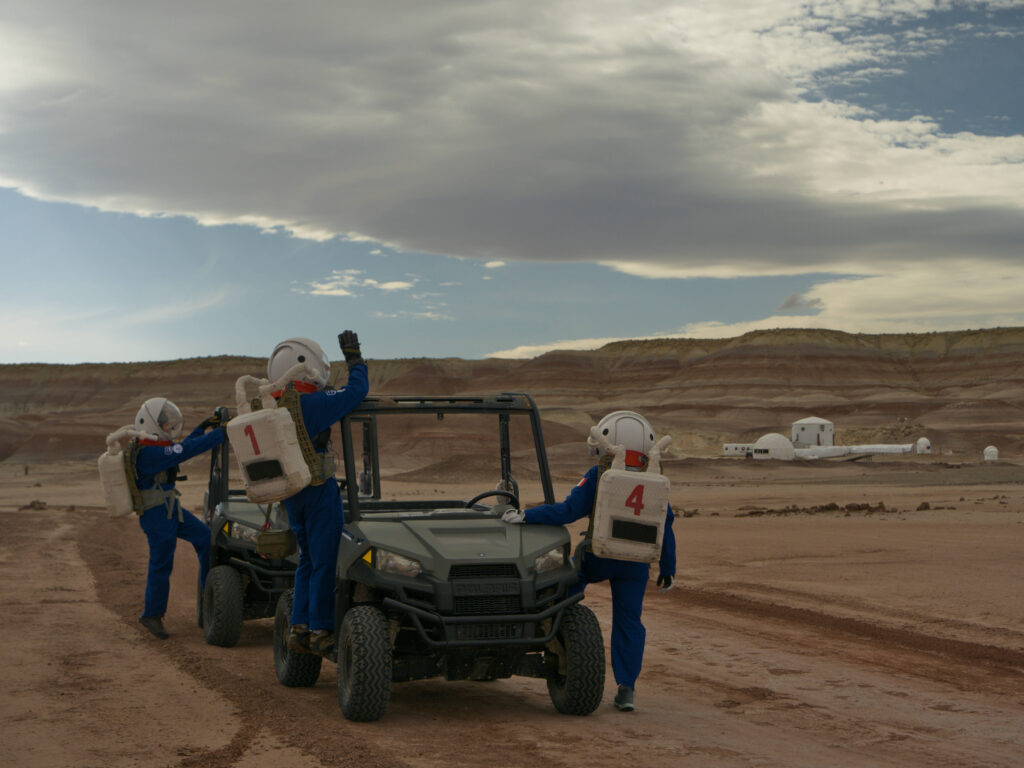
SOL 0 : Crew 330 has landed on Mars
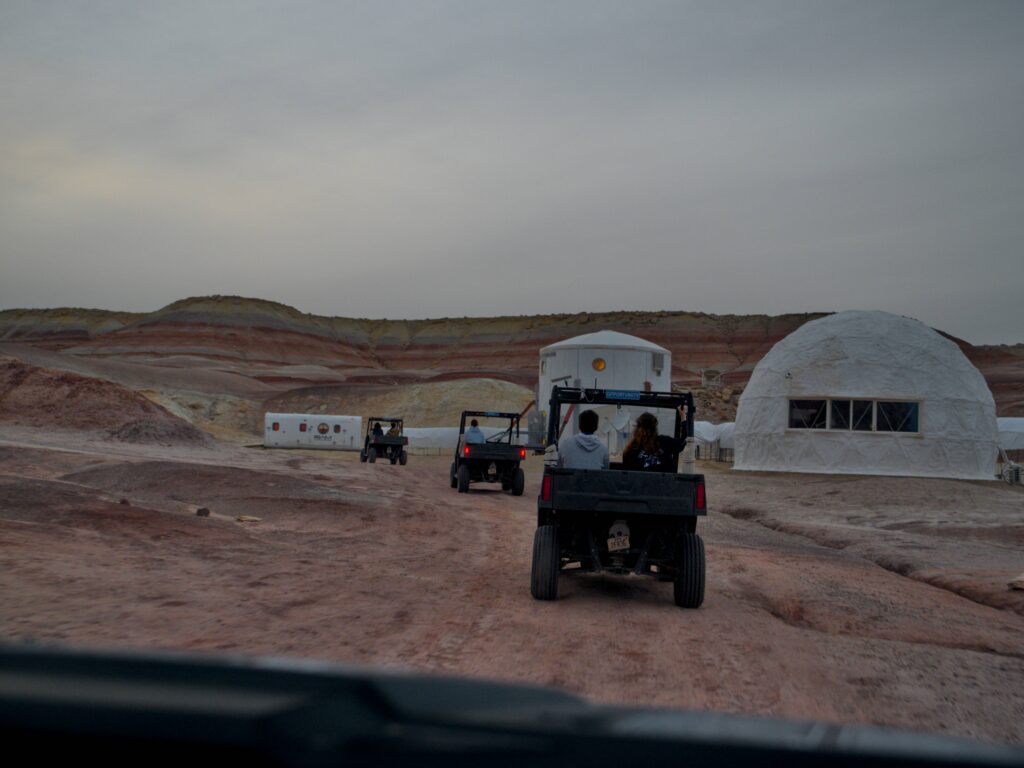
It has been one year since we began preparing our mission, and since we started looking at MDRS pictures, a place which felt so familiar even without ever seeing it with our own eyes.
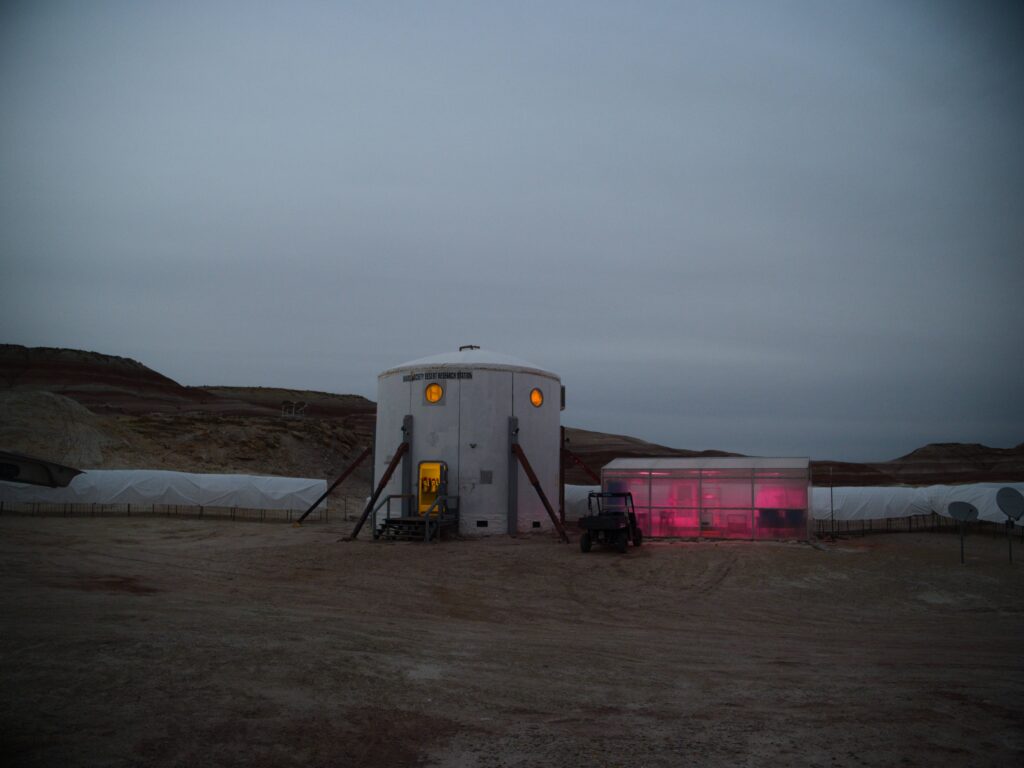
Today, after a three-hour drive from Grand Junction, we left the highway to reach the station and we finally saw it, the Mars Desert Research Station: a place which has been such a huge part of our lives for the past twelve months.
This created a wave of emotions within our crew and it was a very powerful moment we will end up remembering when looking back at the mission.
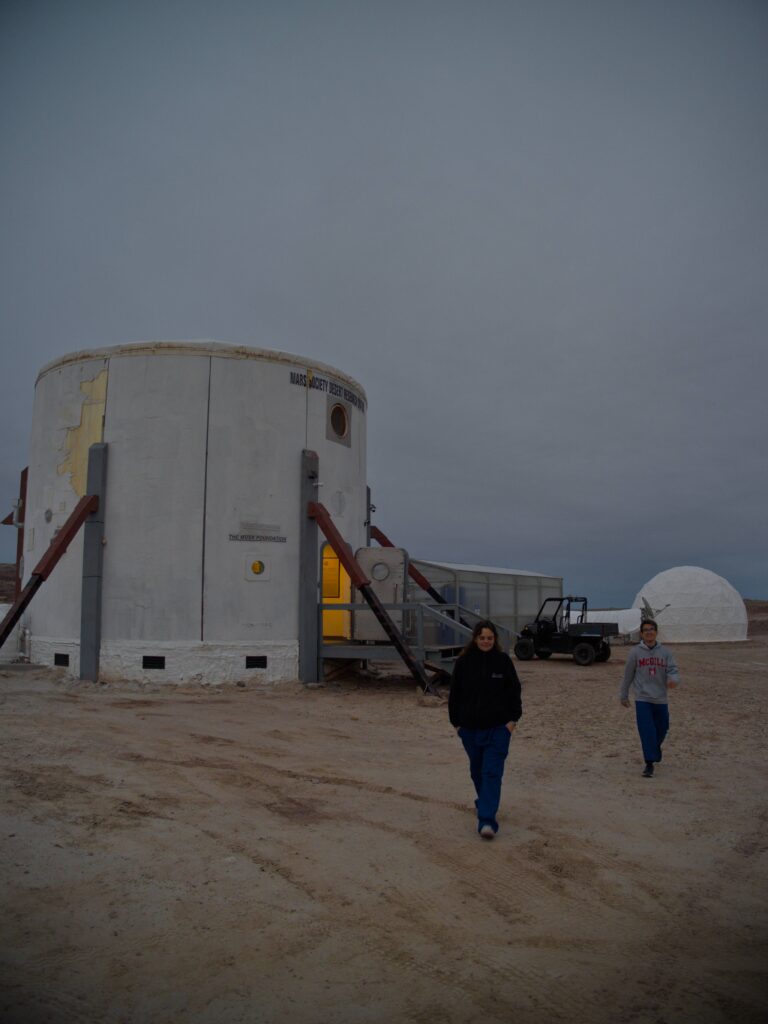

Upon our arrival, we first took the crew picture in front of the station. We then went
through rover training before being taught every functionality of the station. We
finished late so we could not go and eat a last meal in town before entering the
simulation.
It was half past midnight when we symbolically closed the station. We shut
down all communications and officially entered our one-month Martian analog
mission.
Tomorrow we will live our very first day on Mars.
CREW 330
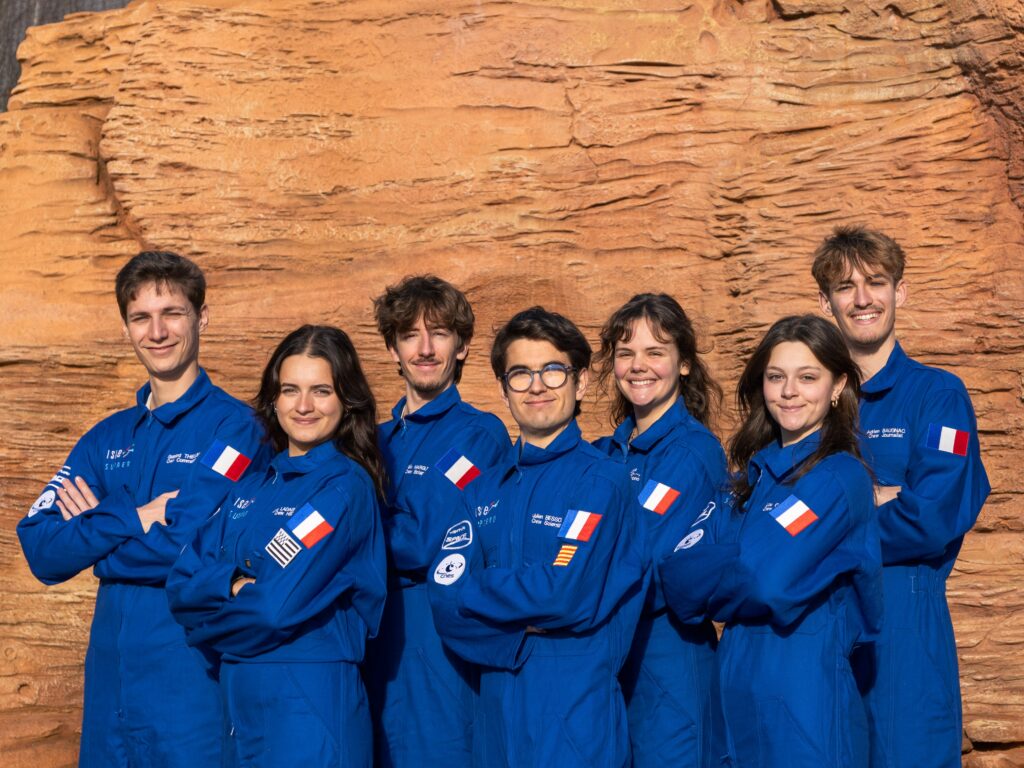
In about 20 days, the Crew 330 will be starting its mission. Today, we are presenting each member and their roles !

Célia Parnaud–Amy – Astronomer
“What I am most grateful for in the mission is the strength of our team, which will soon be flying off to the Utah desert!
In high school, my parents gave me a small telescope, and the first time I saw the Moon through it was a real revelation.
As the mission’s astronomer, I am extremely fortunate to be able to use the base’s telescopes, including several night telescopes that will allow me to see the magnificent starry sky of Utah ⭐️
The MDRS mission is a combination of human, scientific, and technological adventure. Thank you to my fellow adventurers for being here, and thank you also to all the people who have guided us. Thank you to my parents for the telescope that changed everything for me :))
I also hope that this mission will enable young people who have not previously considered this career path to learn more about space and perhaps decide to pursue it themselves. 🚀”
Julien Besson – Scientist
“After growing up in the Paris area, I had the opportunity to pursue my studies at McGill University, where I learned alongside students from all over the world. This experience made me realize that, despite our different cultures and perspectives, we were united by a shared ambition: advancing science.
Today, my role as Crew Scientist within MDRS Crew 330 allows me to contribute my small part to space exploration by testing new technologies that will also improve life on Earth.
But this mission goes beyond conducting experiments. In an increasingly uncertain world, I have my heart set on showing younger generations that believing in your dreams and in science is essential to building a better future.
Because a crewed mission to Mars is, above all, a human adventure: a collective experience that will push us to go beyond our limits, while keeping our feet on the ground.”


Adrien Saugnac – Journalist
“It will soon become a habit. Writing to you every day and sharing a month of human and scientific adventure, that is the journalist’s role.
I have always been passionate about science, especially space, which guided my studies. When I learned that students take part each year in a simulated Martian mission, I didn’t hesitate to apply. I enjoy discovering new things, facing challenges, trying to overcome them, and sharing these moments with others, making them even more meaningful.
As the mission journalist, I want to leave a lasting trace of what we will experience and feel, both for the crew to relive this intense month, and to welcome you into our daily life as seven humans isolated in the Utah desert.”
Adèle Ladagnous – Health and Safety Officer
“As an athlete, musician, and psychology enthusiast, I am sensitive to what drives us to excel. Whether on a volleyball court or during a mission such as the MDRS, success is inseparable from teamwork.
In my daily life, I am committed to taking care of my loved ones. I try to be a helpful and comforting presence for them. As HSO, my priority will be to take care of our crew and ensure our Physical and Psychological well-being.
Analyzing our cognitive performance in a confined environment is essential, because human adaptation remains one of the greatest challenges of future space exploration: how will we react, together, physically and mentally, when faced with the unknown?
I also hope to continue talking about our mission and my career path in schools and perhaps help young girls to envisage careers in science and… to dare!”


Lou Goiffon – Crew engineer
“I grew up in a family that taught me to be manual, creative and ambitious, between the ocean and the thermal of the Arcachon Basin, extreme sports and artistic activities, DIY and fiddling. This interest in space has therefore naturally grown with me, as space is a combination of everything that attracts me.
Since always, I have been driven by my desire to step out of my comfort zone and discover myself. I seek to create, explore, and make sense of what I undertake.
This mission is an opportunity for me to discover myself in a new environment, to forge strong links with my crew and to inspire younger people to follow paths they didn’t even consider. Being able to contribute to space research that impacts all fields is for me both a dream and a challenge.
As the mission’s on-board engineer, I can discover a new environment and put my creativity and technical skills to the test !”
Félix Marguet – GreenHab Officer
“Curiosity is, in my view, one of the most important qualities in a mission of this scale. It allows us to move forward, to build the project step by step, and to develop true scientific rigor as well. I believe, and this works out quite well, that it is a strongly shared character trait among all members of the crew.
For me, the MDRS represents a genuine human, scientific, and professional opportunity. When I first discover this mission, I immediately pictured myself in the station in the middle of Utah, without ever taking it for granted.
At first, you don’t think about everything that comes with it, and in particular, you don’t necessarily think about science outreach. Science outreach along with the other crew members, carries you forward when things are not going well and reminds you of the meaning of the mission through the intense curiosity of young students.”


Gaspard Thieulin – Commandant
“As a child, people sometimes said I had my head in the clouds. In reality, I’ve always had my head in the stars, dreaming of going to space one day.
As a practitioner of unusual and sometimes extreme sports, I love adventure and discovering new sensations. This passion is also what led me, in 2019, to apply for a mission at the MDRS. It was an unforgettable experience, shared with an exceptional Crew 206, with whom we lived through the intense moments of a simulated Martian life. In a few weeks, I will be heading back to Mars as the Commander of Crew 330. It is a tremendous honor and a great joy to take part in this new adventure, once again alongside an incredibly warm and highly skilled crew.I thank them for trusting me to lead and support them throughout our four-week mission, which I am very much looking forward to experiencing to the fullest.”